.png)


We’re currently surveying current and former UK renters about their experiences with tenancy deposit deductions. We wanted to understand how often deductions occur, what they’re for, whether renters think they’re fair, and what happens when they don’t.
The responses paint a troubling picture: most renters have faced deductions, most believe they were unfair, and very few have the evidence or confidence to challenge them effectively.
Here’s what our data shows.
Most renters have been asked to accept deposit deductions
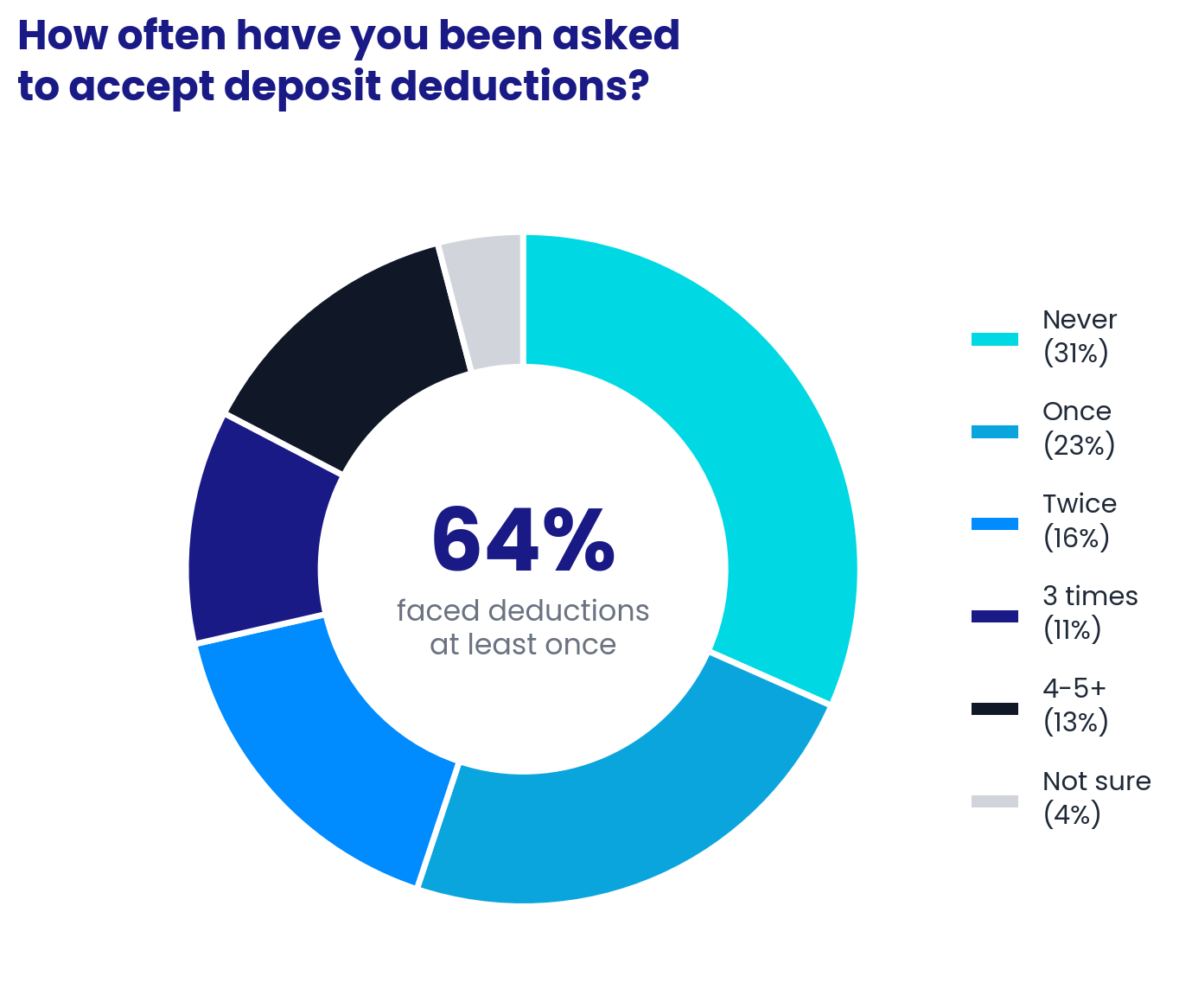
Nearly two-thirds (64%) of those 150 respondents said that they’d been asked to accept deposit deductions at least once. And this isn’t a one-off experience for most of them: 41% had faced deductions across multiple tenancies. Only 31% had never been asked to accept a deduction.
The thing is, deposit deductions aren’t supposed to be routine. A landlord can only deduct from a deposit for specific, evidenced reasons, such as:
- Actual damage beyond fair wear and tear
- Cleaning costs when the property was left in a worsetate than it was received
- Unpaid rent
If the majority of renters are losing money at the end of a tenancy, and an overwhelming majority (as we’ll see later) believe deductions were unfair, something in the system isn’t working as it should.
Cleaning is the number one deduction, by a wide margin
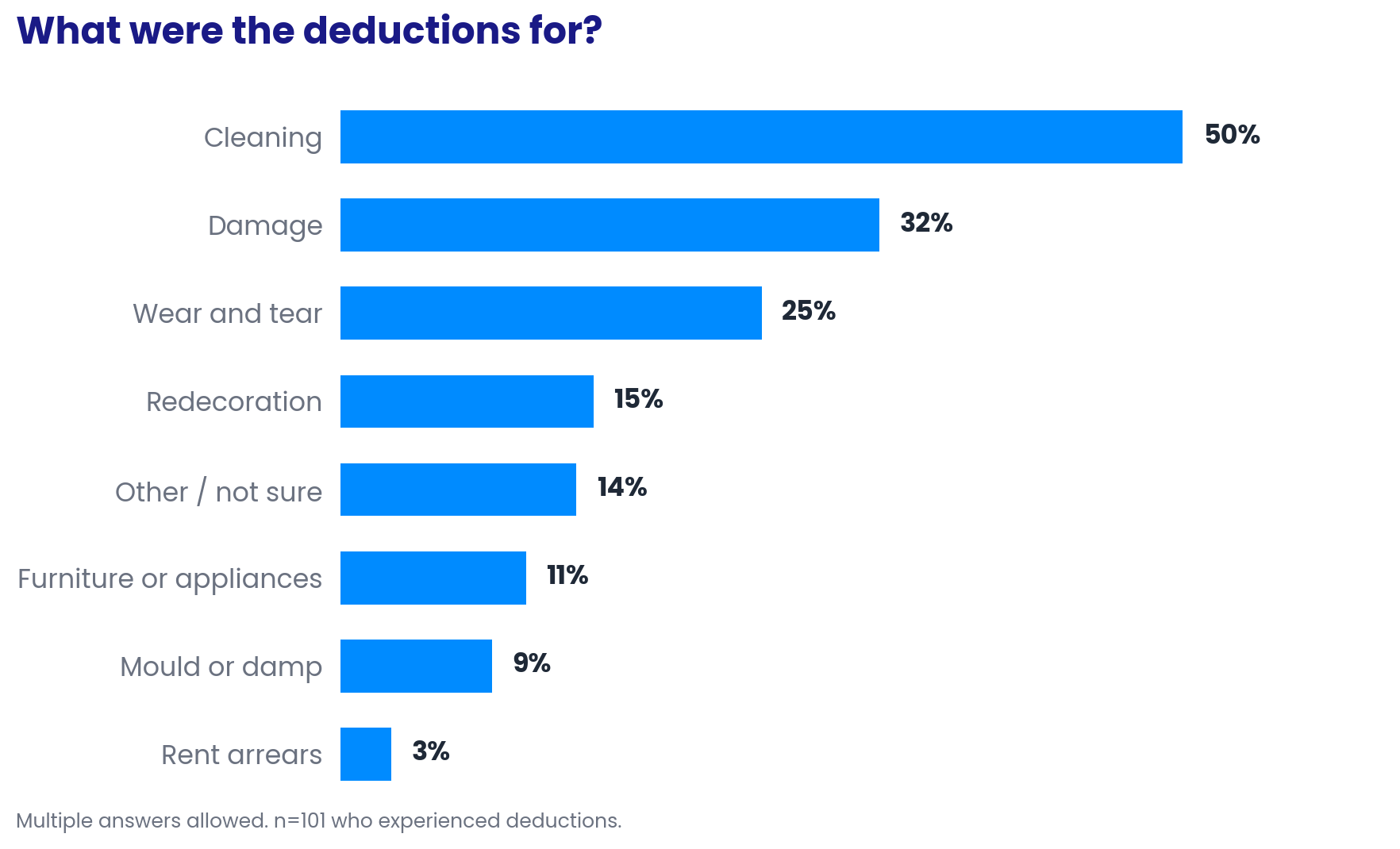
When we asked what deductions were for, cleaning dominated. 50% of all respondents who had experienced deductions said cleaning was cited as a reason. Damage came second at 32%, followed by wear and tear at 25%, and redecoration at 15%.
This aligns with what deposit protection schemes have reported in the past. Cleaning and damage are consistently the top two categories in formal disputes that reach adjudication through the DPS, TDS, and MyDeposits.
But the fact that a quarter of renters said they were charged for "wear and tear" is worth pausing on. In law, a landlord cannot deduct for fair wear and tear. It's one of the most misunderstood areas of deposit disputes, and our data suggests plenty of renters believe that they were charged for it anyway.
Only 11% thought the deductions were fair
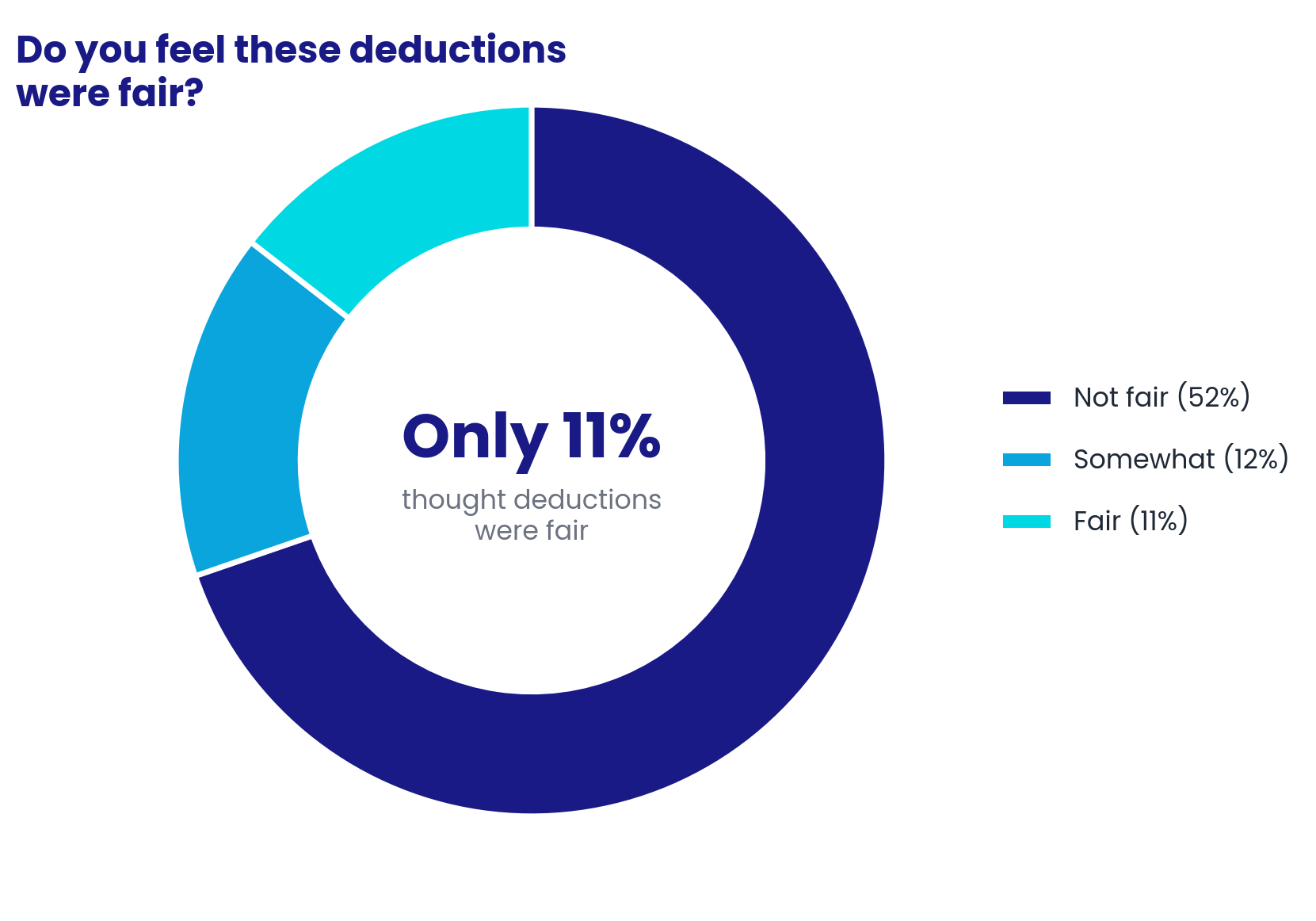
Of those who had experienced deposit deductions, just 11% said they considered them to be fair. Over half (52%) said the deductions were unfair, with 12% saying that the deductions were “somewhat” fair.
We gave respondents the option to tell us why they felt the deductions were unfair, and the reasons clustered around a few recurring themes:
- 57% said the charges seemed excessive or inflated. This was the most common complaint. Renters described being charged amounts that didn't match the scale of the issue or receiving invoices that felt disproportionate.
- 46% said the problems existed before they moved in. Nearly half of those who considered their deductions unfair said the issues they were being charged for were already present at the start of the tenancy. If a problem existed before move-in but wasn't properly documented, the renter has no way to prove it at move-out.
- 38% said the issues were caused by the landlord's lack of care or maintenance. Problems that should have been fixed during the tenancy, but weren't, were being passed to renters as deposit deductions.
- 38% said they were charged for natural wear and tear, not damage. Renters are being asked to pay for the kind of gradual deterioration that comes with actually living in a property, which is not a lawful basis for a deduction.
- 20% said they were charged for a fault they had reported, but that was never fixed. One in five respondents in this group had actively flagged an issue to their landlord, received no repair, and were then deducted for that same issue at the end of the tenancy.
Nearly half lost more than £150
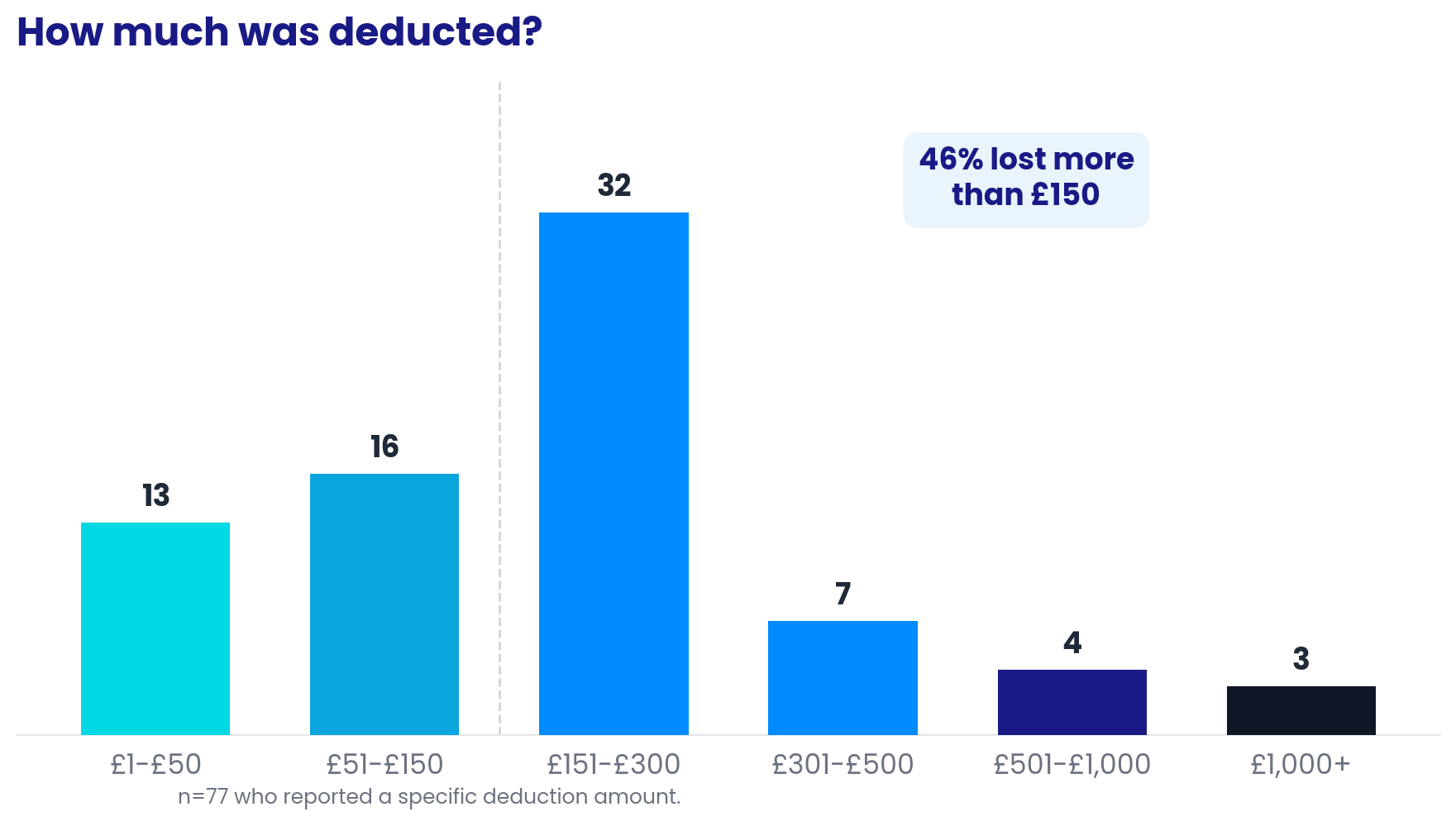
When we asked how much was deducted in their most recent tenancy, the amounts were not small. 46% of those who faced deductions lost more than £150. Almost a third lost between £151 and £300, and a smaller but notable group lost between £301 and £1,000 or more.
For context, the maximum deposit in England for a new tenancy is five weeks' rent. On a £1,200/month rental, that's £1,385, and a £200 deduction from that is a meaningful chunk of the money a renter needs to put down on their next home.
Most renters don’t challenge deductions
Every renter whose deposit is protected with a government-approved scheme (the DPS, TDS, or MyDeposits) has the right to challenge deductions through a free alternative dispute resolution process. An independent adjudicator reviews the evidence from both sides and makes a binding decision.
But our data suggests most renters don't get that far.
Of those who experienced deductions, 38% challenged informally (by email or phone), and only 18% used the deposit scheme's formal process. Another 18% didn't challenge at all. The reasons our respondents chose not to challenge deductions include:
- “I didn’t think I would win” (9%)
- “Too much time and hassle” (28%)
- “I didn’t know how to” (15%)
- “I didn’t have enough evidence” (22%)
When you look at the state of move-in documentation, the lack of confidence among renters starts to make sense:
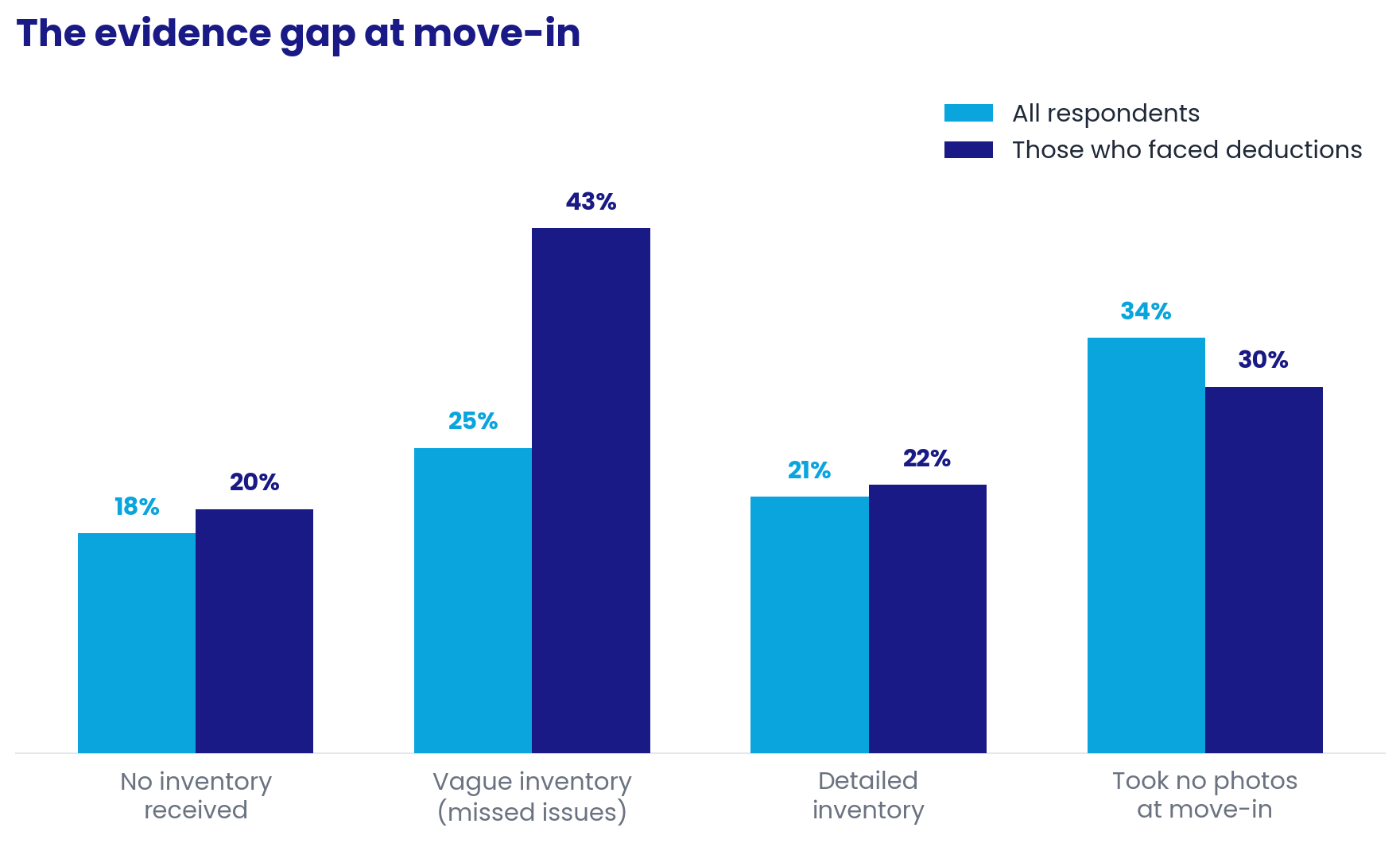
Only 21% of respondents said they received a check-in inventory that was detailed and showed all pre-existing issues, while a quarter (25%) received one that was vague and missed pre-existing problems. And 18% didn't receive one at all. That means over 40% of renters started their tenancy with either a flawed record of the property's condition or no record whatsoever. Among those who had actually faced deductions, 63% had either no inventory or one that missed pre-existing issues.
Personal documentation wasn't much better. Over a third (34%) of all respondents said they took no photos or videos of the property at move-in. Only 28% said they took "a lot of detailed" photos or videos. The rest took some, but not systematically.
And when we asked how confident renters felt that they could prove a pre-existing issue if a dispute arose, the average score was just 6.1 out of 10. More than a third (38%) scored themselves at 5 or below.
What does all this mean for renters?
The deposit dispute system in England isn't broken by design. The three government-approved schemes (DPS, TDS, and MyDeposits) all offer free adjudication services, and the process is designed to be accessible without legal advice.
But the system depends on evidence, and our survey suggests that most renters aren't entering tenancies with the documentation they'd need if things go wrong at move-out. If you don't have clear, dated proof of the property's condition, challenging a deduction at move-out is a gamble. And when it feels like a gamble, most people don't bother. That cycle is self-reinforcing: if most tenants don't challenge, there's no pressure on landlords to stop making questionable deductions in the first place.
So, if you're moving into a new rental property, three things matter more than anything else:
Document the property’s condition when you get the keys
Photograph every room, every surface, every mark, and every appliance. If something is already damaged, stained, or worn, capture it with context: wide shots to show the room, close-ups to show the detail. Do this as soon as you can, when you’ve got your keys, ideally on the same day but definitely in the same week.
Don’t rely on the landlord’s inventory
Even if you receive a detailed check-in report, create your own independent record. If the inventory misses something, or if you disagree with how a room's condition has been described, note it in writing and send it to the landlord or agent within the first week. Don’t expect the agent to update their inventory, though; you’re not the agent’s customer, and they probably won’t even read your email, let alone respond to it.
Keep everything organised and timestamped
In a dispute, an adjudicator will look at the evidence from both sides. Dated, structured documentation of the property's condition at move-in and/or move-out is the single most important thing you can have. Undated photos in a camera roll are better than nothing, but they're not ideal.
This is what we built Deposit Guard to help with. You photograph each room, note the condition of surfaces, fixtures, and appliances, and we generate a timestamped, immutable condition report you can keep and refer back to if you ever need it.
The good news is that the process for challenging a deduction is free, binding, and available to every renter with a protected deposit. The problem isn't in the system itself, but what renters bring (or, in this case, don’t bring) to it.
About our survey
The survey was distributed online, and responses were collected anonymously. The sample is self-selected and not nationally representative, but the consistency of the findings across respondent groups and their alignment with published data from the deposit protection schemes suggest the patterns described here reflect wider trends in the private rental sector.